
WAVE – Influence of Water Level Fluctuations on Aquatic Vegetation
- Contact:
- Project Group:
Vegetation
- Funding:
DFG
- Partner:
Anne Lewerentz, TBD
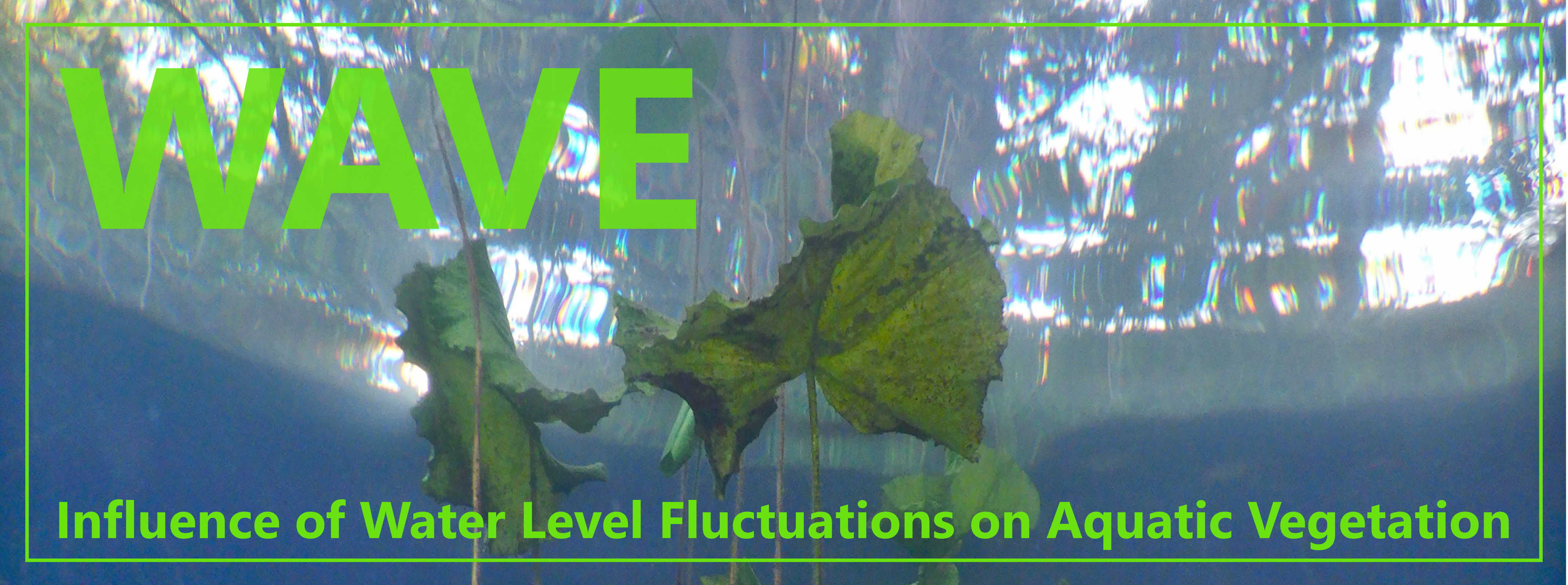
Macrophytes are important for freshwater ecosystems
Macrophytes are important species for the functioning of freshwater ecosystems. However, their populations are declining in lakes worldwide. Three causes of this decline have been well studied: increasing nutrient availability, rising water temperatures, and increasing turbidity.
Water level fluctuations are a less well-known influencing factor
These three factors, in turn, depend on water level. Water level fluctuations occur as recurring seasonal variations or as a result of extreme events such as high and low water levels. We understand their effects on macrophytes less well.
Water level fluctuations directly influence growth as soon as the plants’ tolerance for flooding or desiccation is exceeded. They also alter water depth and, consequently, light availability. Indirectly, they affect nutrient availability, water temperature, and turbidity.
Targets
In WAVE, we aim, on the one hand, to understand how water level fluctuations over the past decades are related to the current distribution and species diversity of macrophytes in lakes. Second, we are investigating how future fluctuations will alter the growth, distribution, species diversity, and functional characteristics of the plants.
Approach
- We statistically analyze existing data from open databases in southern Germany and examine whether the distribution and species richness of macrophytes depend on the water level regime.
- We develop and expand a process-based macrophyte growth model that simulates growth under changing environmental conditions, including fluctuating water levels. We parameterize it independently of empirical species data, using trait data from the literature and a virtual-species approach.
- Using the validated model, we run through various scenarios: altered seasonal fluctuations and more frequent extreme events.
Project Contribution
WAVE provides new insights into the ecological mechanisms that govern the response of macrophytes to water level fluctuations. In this way, the project contributes to a better understanding of freshwater biodiversity under changing climate conditions. This knowledge is essential for developing strategies to adapt to the expected changes and for protecting biodiversity and ecosystem services in lakes.